
How to solve parallel members with an initial gap (statically indeterminate)
Round bars of differing length are clamped side by side between a rigid wall and a rigid plate. Equilibrium alone does not close the problem, so a compatibility condition is added; this page follows that through to the displacement of the plate and the reaction in each bar.
Formulas
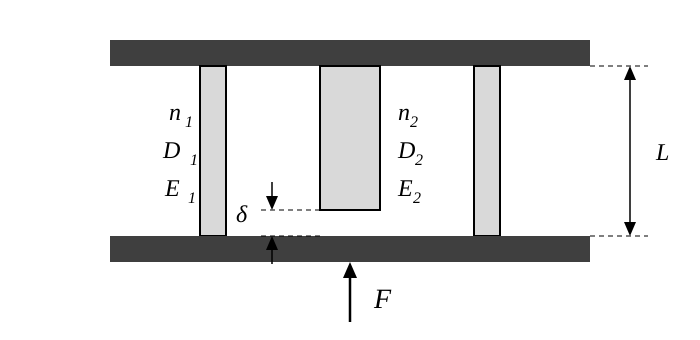
Members of differing length are clamped side by side between a rigid wall and a rigid plate. The plate is taken to move parallel to itself without tilting. Member 2 is shorter than member 1 by , so it carries no load until the plate has moved by .
1. Equilibrium of forces
Equilibrium of the forces on the rigid plate. There are two unknowns, and , and only this one equation, so it cannot be solved on its own — the problem is statically indeterminate.
2. Compatibility of deformation
The missing equation comes from the deformation. The plate moves parallel to itself, so writing its displacement as , member 1 shortens by . Member 2 is shorter by , and of that movement goes into closing the gap, so what member 2 actually shortens by is the remaining .
Hooke's law, written with each member's own length. The length of member 2 is , not .
3. Solve the two together
Substituting the two into the equilibrium equation and solving for .
Once is known, the reactions follow from the two equations above. Taking the bars as round, the cross-sectional area and the stress are and .
The approximation is not used. When is small compared with the result barely changes, but it is kept exact so that the formulas written here and the calculated result do not disagree once a large is entered.
4. When member 2 makes no contact
While the load is small enough that , member 2 is not yet touching the rigid plate and carries no force. Applying the formula in step 3 anyway gives , which makes negative — it would mean the shorter member 2 is pulling the rigid plate, and that cannot happen.
The calculator therefore first works out with member 2 ignored, and switches to the formula in step 3 only when that value is at least .
While there is no contact, the shortening, the reaction and the stress of member 2 are all zero. The calculator states which of the two states applies above the results.
Sign convention
Compression is taken as positive. In this model the applied force, the reactions and the stresses are all compressive, so taking tension as positive would line up every value as a negative number and make the screen harder to read.
- Applied force — positive in the direction that pushes the rigid plate towards the wall
- Reactions and — positive in the direction that compresses the member, that is, the direction in which it pushes back on the plate
- Stresses and — compression positive
- Shortening and — positive in the direction of shortening. The displacement of the rigid plate follows the same convention
- Gap — how much shorter member 2 is than member 1. Enter zero or more
Related pages
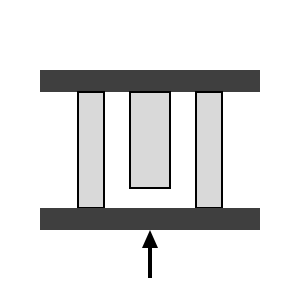
The calculator that uses the formulas explained here to work out the displacement of the rigid plate, the reaction, stress and cross-sectional area of each member.
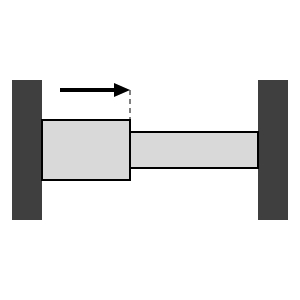
The same kind of indeterminate problem, but with the members in series. There the compatibility condition takes the form "the two extensions sum to zero".