
How to solve a bar fixed at both ends (statically indeterminate, in series)
A bar fixed to rigid walls at both ends carries an axial load at an intermediate point C. Equilibrium alone does not close the problem, so a compatibility condition is added; this page follows that through to the reactions and the displacement of C, and sets out the sign convention and how to check the result.
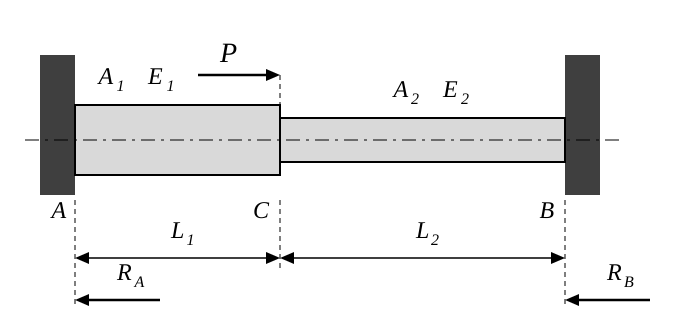
Determinate and indeterminate
A problem that equilibrium alone can solve is statically determinate; one that it cannot is statically indeterminate. This bar has two unknown reactions, and , but only one equation of axial equilibrium. One equation short, the forces alone do not settle the answer.
The missing equation comes from the deformation. The walls at both ends do not move, so the overall length of the bar is unchanged under load. Writing that down gives a second condition, independent of force equilibrium. Thinking about the deformation is the heart of an indeterminate problem.
How to solve it
1. Write the equilibrium equation
Taking the whole bar as one body and balancing the axial forces.
Two unknowns, one equation. Stopping here is what makes the problem indeterminate.
2. Write the compatibility condition
Cutting the bar at C, the axial force in section 1 is (tension) and in section 2 is (compression). Hooke's law gives the extension of each as follows.
With both ends held, the overall length cannot change, so the two extensions sum to zero. That is the compatibility condition.
3. Solve the two together
Writing the stiffness of each section as , the compatibility condition becomes . Solving it together with the equilibrium equation fixes the reactions and the displacement of C.
The reactions are shared in proportion to the stiffnesses. It helps to picture two springs either side of C sharing the load. The stiffer side — the larger k — takes the greater reaction.
When area and modulus are the same throughout
When and , the stiffnesses are and , so cancels out of the formulas above and only the lengths remain.
Each reaction is proportional to the length of the section on the far side. The shorter side is the stiffer one, so it takes the larger reaction. The answer does not depend on the material because cancels; step the section or change the material and it no longer cancels, and the stiffness form above is needed.
Sign convention
Getting a sign wrong is the biggest trap in an indeterminate problem. This tool takes the following directions as positive. Check them before reading the results.
| Quantity | Positive direction | Notes |
|---|---|---|
| Load P | From A towards B | If it acts the other way, enter P as a negative value. Every result simply flips sign. |
| Axial force N | Tension | With P > 0, section 1 is in tension and positive, section 2 in compression and negative. |
| Reaction R | The wall pushing back on the bar (opposite to P) | Taken this way, both are positive when P > 0 and the balance reads R_A + R_B = P. |
| Stress σ | Tension | It carries the sign of the axial force. Negative means compression. |
| Extension λ | Extension | Negative in a section that shortens. The two sum to zero. |
| Displacement of C, δ_C | From A towards B | The same value as the extension of section 1, λ₁. |
How to check the result
Whatever the inputs, these two always hold. If they do not, suspect the units or the direction of an input.
- Equilibrium: . The two reactions add back up to the load
- Compatibility: . This is the "total extension" in the results, and it comes out as zero
Related pages
The calculator that uses the formulas explained here to work out the reactions, axial forces, stresses and extensions.
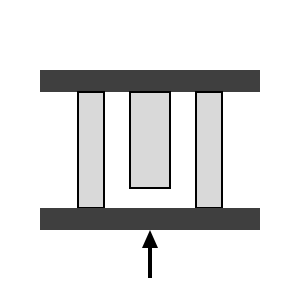
The same kind of indeterminate problem, but with the members in parallel. There the compatibility condition takes the form "the rigid plate has one displacement".