
Statically indeterminate parallel members with an initial gap
A statically indeterminate problem in which round bars of different lengths are held in parallel between a rigid wall and a rigid plate. There is a gap at the shorter member, so while the load is small only the longer member carries it. Finds the displacement of the rigid plate, the reaction and stress in each member, and the cross-sectional areas.
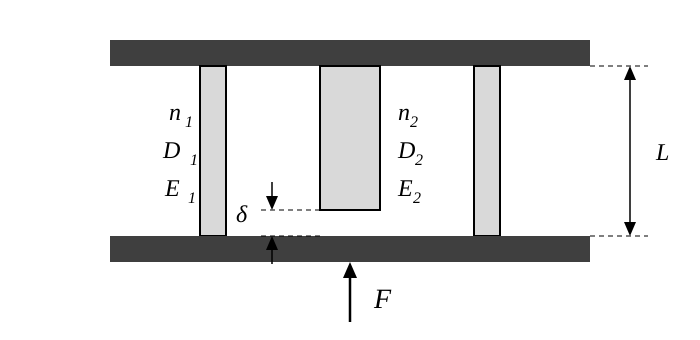
Input
Result
Notes
- Reactions and stresses are given per member. The totals are for member 1 and for member 2, and they add up to the applied force .
- The wall and the plate are taken as rigid, and the plate is assumed to move parallel to itself without tilting. This calculation does not cover a plate that bends, or one that tilts because the members are unevenly placed.
- Members are treated as round bars, with the area taken as . Buckling is not checked. Check it separately when a slender member is in compression.
- leaves member 2 with zero or negative length, so nothing can be calculated. Enter a gap smaller than the length of member 1.
- The applied force is assumed to push. Enter it pulling — a negative value — and the rigid plate lifts off the members, which this calculation does not describe.
Related pages
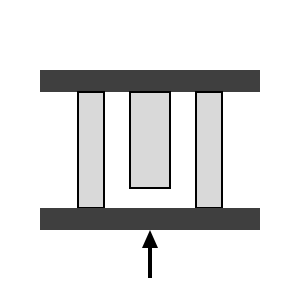
Walks through adding the compatibility condition to the equilibrium equations, what to do while the shorter member is not yet in contact, and the sign convention.
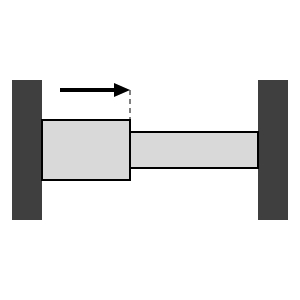
A statically indeterminate bar fixed to walls at both ends, loaded axially somewhere along its length. The members sit in series here, so the compatibility condition reads: the two extensions sum to zero.

Stress from a temperature change in a restrained member. Working from the expansion the restraint cancels is the same compatibility argument.