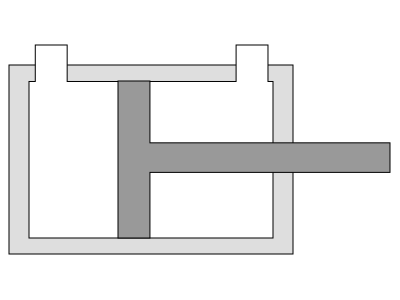
How an air cylinder behaves
This page gathers the points to settle first when choosing an air cylinder. The thrust can be calculated, but the speed it can move at and the temperature it can work in differ from maker to maker, so it separates what the calculation settles from what only a catalogue can settle.
Working out the thrust
The force the compressed air puts on the piston is the pressure area times the pressure. On the extend stroke the whole face of the piston takes the pressure.
is the tube bore [mm] and the working pressure [MPa]. Because 1 MPa = 1 N/mm², multiplying the area [mm²] by it gives the force [N] directly.
On the retract stroke the cross-section of the rod is subtracted. That is why, at the same pressure, the retract thrust is the smaller of the two.
Load factor
A design does not use up the whole theoretical thrust. Friction and the delay in the pressure building up mean that a margin is needed. How that margin is taken is the Load factor .
- Static clamping or slow motion: about 0.7
- General transfer: about 0.5
- Fast motion: about 0.35
- With impact: 0.3 or less
Mass a bore can lift
The table applies the formula above to give a guide to the mass each bore can lift vertically. You can change the working pressure and the load factor to see the effect.
| チューブ内径 D [mm] | 受圧面積 A [mm²] | 理論推力 F [N] | 負荷率を掛けた推力 [N] | 持ち上げ質量の目安 [kg] |
|---|---|---|---|---|
| 2.5 | 4.909 | 2.454 | 1.718 | 1.752e-1 |
| 4 | 12.57 | 6.283 | 4.398 | 4.485e-1 |
| 6 | 28.27 | 14.14 | 9.896 | 1.009 |
| 8 | 50.27 | 25.13 | 17.59 | 1.794 |
| 10 | 78.54 | 39.27 | 27.49 | 2.803 |
| 12 | 113.1 | 56.55 | 39.58 | 4.036 |
| 16 | 201.1 | 100.5 | 70.37 | 7.176 |
| 20 | 314.2 | 157.1 | 110 | 11.21 |
| 25 | 490.9 | 245.4 | 171.8 | 17.52 |
| 32 | 804.2 | 402.1 | 281.5 | 28.7 |
| 40 | 1257 | 628.3 | 439.8 | 44.85 |
| 50 | 1963 | 981.7 | 687.2 | 70.08 |
| 63 | 3117 | 1559 | 1091 | 111.3 |
| 80 | 5027 | 2513 | 1759 | 179.4 |
| 100 | 7854 | 3927 | 2749 | 280.3 |
| 125 | 1.227e+4 | 6136 | 4295 | 438 |
| 140 | 1.539e+4 | 7697 | 5388 | 549.4 |
| 160 | 2.011e+4 | 1.005e+4 | 7037 | 717.6 |
| 180 | 2.545e+4 | 1.272e+4 | 8906 | 908.2 |
| 200 | 3.142e+4 | 1.571e+4 | 1.100e+4 | 1121 |
| 250 | 4.909e+4 | 2.454e+4 | 1.718e+4 | 1752 |
| 300 | 7.069e+4 | 3.534e+4 | 2.474e+4 | 2523 |
The figures are a guide for lifting vertically. The thrust needed to move a load horizontally follows from friction and from the acceleration, not from the mass, so this table cannot give it.
Check these in the catalogue
The following differ from maker to maker and from series to series. They cannot be settled by calculation, so check the catalogue for the series you are using.
- Minimum operating pressure: the lowest pressure at which the cylinder starts to move. It is set by the friction of the seals, so it differs from series to series. It matters when you work at low pressure
- Speed range: the upper and lower limits on speed. If you work at low speed, check the lower limit at which stick-slip (juddering) does not appear
- Ambient and fluid temperature: set by the material of the seals. A low-temperature or high-temperature version is sometimes offered separately
- Life: given as a travel distance. It is usually published together with the test conditions, and a different condition gives a different result. Note that it is not a guaranteed value
- Allowable load at the rod end: the limit on the side load that can be put on the rod. It falls as the stroke gets longer