
How Hertzian contact stress is worked out
A ball on its raceway, a wheel on a rail, a cam on its follower — this works out the stress where two curved surfaces meet. Treated as rigid bodies they would meet at a point or a line, and with zero area no stress can be found. In reality both deflect a little and meet over a finite area; Hertzian contact stress is that area and pressure derived from elasticity.
When it applies
It only applies where the following three hold. Outside them the value found here is not even a rough guide.
- The contact area is small enough compared with the bodies themselves — the material around it has to be treatable as a half-space
- The deformation stays within the elastic range. Once it yields, the formulas no longer hold
- There is no sliding and no friction at the interface. Tangential forces are not considered
The lubricant film, fatigue under repeated load and surface roughness are not included either. Do not judge a problem where those dominate — rolling bearing life, for instance — from these formulas alone.
Combining the two bodies into one
Before the formulas, the shape and the material of the two bodies are each reduced to a single value. Once those two are fixed, the rest follows from whether the contact is spherical or cylindrical.
Equivalent radius of curvature
The shapes combined into one value, through the sum of the reciprocals.
Equivalent Young's modulus
The materials combined into one value. Poisson's ratio enters here.
has the units of a modulus but is not the modulus of either material. It combines how readily the two bodies deflect, and belongs to this contact only.
Flat and concave surfaces
The formulas do not change with the shape. Only the way is found changes.
Against a flat surface
A flat surface is a curved one of infinite radius. Since , the equivalent radius is simply the radius of the convex side.
Against a concave surface
A convex surface seated in a concave one, as a ball sits in its outer ring. The radius of the concave surface is taken as negative.
is required. If the convex surface is the larger it does not seat, turns negative and the formulas lose their meaning. The calculator rejects inputs that fail this condition.
A concave surface gives a larger than a flat or convex one, so the same load spreads over a wider area and the pressure falls. That is why bearing raceways are grooved.
Spherical contact (point contact)
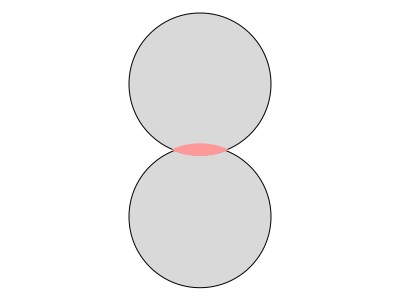
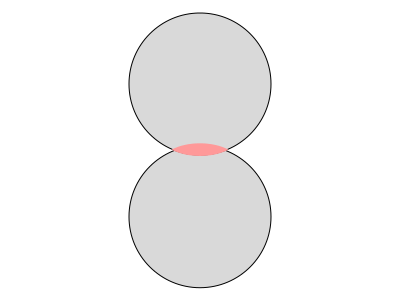
The contact area is a circle. Write its radius as .
How far the centres of the two bodies approach each other.
The pressure over the contact is not uniform but semi-elliptical, highest at the centre and zero at the rim. Writing the distance from the centre as gives the following.
is 1.5 times the mean pressure (the mean being ). Checking with load divided by area therefore underestimates it.
Cylindrical contact (line contact)
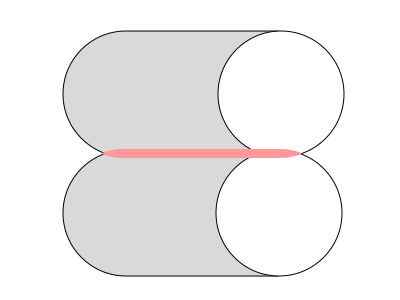
Two cylinders with their axes parallel. The contact is not a circle but a strip; write its half-width as and the length along the axis as .
The pressure is semi-elliptical across the strip.
Here is 4/π ≒ 1.27 times the mean pressure.
The approach is not worked out. In line contact it depends on the shape outside the contact as well, so the Hertz formulas alone do not fix it. The calculator does not output it either.
Contact pressure is not the internal stress
is the greatest pressure acting on the surfaces in contact, not the greatest stress inside the material. Which quantity to look at depends on what you want to check.
- To judge indentation or wear, use — the pressure the surface itself carries
- To judge cracking or spalling, use the internal stress. Rolling contact fatigue starts not at the surface but a little below it
For spherical contact the internal stresses can be written in proportion to .
- Maximum tensile stress — at the rim of the contact circle, on the surface, acting outwards
- Maximum shear stress — directly below the centre of the contact, at a depth of about . With it comes to
The numbers change with . 0.31 and 0.48 are the figures for , roughly the value for steel; another ratio gives other figures. The calculator does not output these values. It goes as far as .
Notes
- is the force normal to the surface at the contact. Resolve self-weight and any external load into the component normal to the interface before entering it
- For cylindrical contact, is the length actually in contact. Near the ends the pressure rises — edge loading — so conditions there are more severe than these formulas suggest
- The calculator also outputs and : when checking against a hand calculation, get these two to agree first.
Related pages
Six calculators: spherical and cylindrical contact, each against a convex, flat or concave surface.
Works out the equivalent radius and modulus, the contact diameter, the approach and the maximum contact pressure.
Enter the contact length to get the contact width and the maximum contact pressure.